Remediating Complex PTSD – “Coming Back to Yourself” - How Therapy Works When Trauma Splits You Apart

“I don’t know how to explain it,” you say. “On the outside I’m functioning… but inside I feel far away. Like I’m missing pieces of myself.”
The therapist nods. “That ‘far away’ feeling is often a sign of dissociation. It’s not weakness—and it’s not that you are failing. It’s a survival skill your mind and body used to get through experiences that were too much, too soon, or too alone. In therapy we don’t rip that protection away. We work in a way that helps you feel safe enough to come back to yourself, step by step.”
What follows is a picture of how the process usually runs: how we build safety, how we work with memories and triggers without overwhelming you, and how your inner world can become connected again—so life and relationships feel less like survival and more like choice.
You hesitate. “Why does it feel like I’m still stuck in things that happened so long ago?”
“Because trauma can interrupt development,” the therapist says. “As children, we’re meant to build inner capacities over time—basic trust, healthy independence, confidence, a sense of belonging, a sense of ‘this is who I am.’ When life isn’t safe or steady, it’s like parts of that inner house didn’t get finished. You may have built an impressive ‘outside life,’ but inside there can be missing rooms: shame where self-trust should be, hypervigilance where calm should be, confusion about needs and boundaries where clarity should be.”
“So, what I’m feeling is… normal?” you ask.
“It’s a common pattern after repeated or relational trauma,” the therapist replies. “Some people call it complex trauma. Your nervous system can get trained to expect danger, even when today is safer. You might swing between feeling too much (panic, rage, tears), and feeling too little (numb, spaced out, ‘not here’). Both are your system trying to cope.”
You nod slowly. “I can be fine at work… and then at home I crash. Or I’ll get triggered and suddenly I’m not myself.”
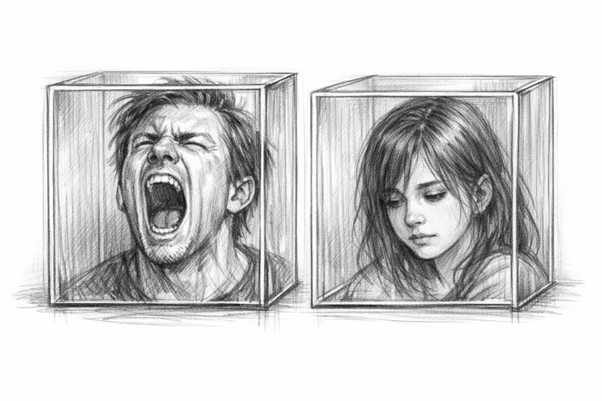
“That makes a lot of sense,” says the therapist. “It can help to think in terms of self-states—parts of you that formed to handle different realities. There may be a capable, ‘functional adult’ part that gets things done; a younger part carrying fear, grief, or unmet needs; and protective parts that shut feelings down or keep you on high alert. None of these parts are ‘bad.’ They’re adaptations. The therapeutic work is to help them connect, so you don’t have to switch abruptly or feel like you disappear.”
“Dissociation protected you,” the therapist continues, “but it can also steal your sense of continuity—like life is happening, but you’re watching from a distance. Therapy aims for reassociation: the gradual linking of what got split apart, so you can be present in your body, in your emotions, and in your relationships.”
“So how does therapy actually work?” you ask. “What do we do in the room?”
The therapist leans forward. “Most trauma therapy follows a simple order, even if we move back and forth: stabilize, process, and integrate. Think of it as building a safe base, then carefully working with what happened, and finally helping your life feel like yours again.”
“Okay,” you say. “So, what happens first?”
“We start in the present,” the therapist says. “Before we go anywhere near the hardest memories, we build a safe base—ways for you to come back when your system gets flooded or when you go numb. Then, when there’s enough steadiness, we approach the past in small pieces: we keep one foot in the room while we touch what happened. And as your nervous system learns it can feel and remember without being taken over, the pieces of you that were forced apart start to reconnect. That’s integration: becoming more you, more often.”
You swallow. “So, we’re not jumping straight into everything.”
“Exactly,” the therapist says. “We work inside your window—enough to create change, not so much that you drown in it. And when we do talk about what happened, we keep it organized and anchored: what happened, how it happened, when, and where. When the story has a sequence, your system doesn’t have to spin in chaos.”
You look relieved—and still unsure. “Okay… but what do we actually do when I’m activated? When I’m panicking or shutting down?”
“We use a roadmap,” the therapist says. “One of the simplest is called IMPRESS A RAVEN. It’s a way of working with stress and trauma responses so your body can settle, your emotions can move, and your mind can make sense—without shame.”
“The first rule,” the therapist adds, “is that we don’t argue with your experience. Early on, details can be fuzzy. If we ‘correct’ you, shame often spikes and dissociation gets stronger. We focus on what your system is doing, help it complete what got stuck, and only later do we reflect and make meaning.”
Immediacy: we respond early—so your system doesn’t have to carry it alone for longer than necessary.
Proximity: you’re not doing it alone; support and attunement matter. We also get as close to the original story as possible—in memory (visually, and in terms of sensory memory, including smell, taste, and body sensations).
Express: you tell what happened in your words, at your pace.
Situational stressor (the sequence): we organize the story—what/how/when/where—so it becomes coherent instead of chaotic.
Affect: we make room for the feelings that belong to what happened.
Release/ventilation: we let the body discharge stuck energy safely (tears, trembling, breath, movement), while staying grounded in the present.
“When these steps happen,” the therapist says, “the experience is less likely to stay stuck in your body and mind. Your system gets to finish what it couldn’t finish back then.”
You exhale. “Sometimes I feel a wave—like panic—and then I go blank.”
“That blankness is often your protection switching on,” says the therapist. “We slow down, bring you back to the room, and help your body settle in small steps. After a release, many people feel relief or tiredness. We make space for that, and we end sessions with grounding, so you leave feeling more here, not more exposed.”
Later in the work, when you’re less overwhelmed, the therapist asks different questions: “What did this change for you? What did you come to believe about yourself? What do you want to reclaim?” This is meaning-making—not forced positivity, but honest understanding. It’s one way coherence returns: the trauma becomes part of your story, not the whole story.
On another day you say, “I keep getting images. Or dreams. And I don’t know what they mean.”
“We can work with that,” the therapist says. “You don’t have to force the memory. We’ll approach it gently.” You describe what you notice—an image, a sensation, a moment in time—while the therapist keeps checking: your breath, your posture, the tension in your chest or belly, the point where you start to drift away. In this way seeing, feeling, and expressing happen together, while one part of you stays anchored in the present.
Sometimes, as you process something recent, a much older feeling shows up. “This doesn’t feel like just this week,” you whisper. The therapist agrees. “Often a present trigger touches a younger part of you. We don’t have to go digging. We simply notice something younger is here. We keep you grounded, help the feeling move in the body, and we return to those earlier layers when you have enough stability to do it safely.”
At some point you notice something surprising: your body is doing as much healing as your mind. Your stomach tightens. Your chest shakes. Your hands go cold. “Am I getting worse?” you ask.
“Not worse,” the therapist reassures you. “Your body is completing what it had to interrupt.” Trauma can trap survival energy—fight, flight, or freeze. In therapy we track what you feel in real time (often in the belly, solar plexus, throat, or chest) and we use breath and grounding to keep you in the present. If trembling, tears, heat, or waves of sensation come, we treat it as the body releasing—while making sure it stays safe and tolerable.
“This is why we go slowly,” the therapist says. “We want facilitated expression, not overwhelm. And we keep separating ‘then’ from ‘now’—so your body learns it doesn’t have to relive the danger to let it go.”
Later, when your system is calmer, you and the therapist look at the story again—this time with more space. You fill in the sequence: what happened, how it happened, when, and where. You notice patterns, triggers, and the beliefs that formed in the aftermath. Nothing is forced. The point is organization: when your story has shape, your inner world has somewhere to put it.
When you get close to the edge—too much emotion, or the pull to go blank—the therapist pauses with you. You name what you see in the room. You feel your feet. You slow your exhale. “We’re here,” you are reminded. “It’s not happening now.” That pacing is part of the treatment: your nervous system learns you can approach the truth and still stay present. Toward the end of each session, you do a brief recap and grounding, so you leave with your awareness connected rather than scattered.
“Can you tell me what to expect?” you ask. “Like… practically?”
Pacing: we won’t force memories. We build stability first and only go as fast as your system can handle.
Skills in the room: grounding, breath, and “coming back” are part of the work—not a detour from it.
Story with anchors: we keep the sequence clear (what/how/when/where) so the experience becomes organized, not overwhelming.
Parts are welcome: different self-states may show up (the competent part, the younger hurt part, the numb/protective part). We work with them, not against them.
Body work: sensations, shaking, tears, tightness, heat, or fatigue can be signs of release—always kept safe and tolerable.
Meaning comes later: once things settle, we explore the beliefs and meanings that formed—and what you want to reclaim.
End-of-session closure: we recap, ground, and make a plan so you leave more connected, not raw.
The therapist smiles gently. “And over time, here’s what we’re building.”
Cohesion: the parts of you that had to separate for survival begin to connect and cooperate—so you feel more whole inside.
Coherence: your story starts to make sense—without shame and without the trauma taking over your identity.
Reassociation: you can stay present in your body and feelings, even when you remember difficult things.
As this happens, relationships often improve—not because life becomes perfect, but because you can notice triggers earlier, set clearer boundaries, ask for what you need, and stay connected to yourself while you connect to others. The goal is an internal world that you no longer have to avoid: one that feels lived-in, understandable, and yours.
References & further reading:
Herman, J. L. (1992). Trauma and Recovery: The Aftermath of Violence—from Domestic Abuse to Political Terror. Basic Books.
International Society for the Study of Trauma and Dissociation (ISSTD). (2011). Guidelines for Treating Dissociative Identity Disorder in Adults, Third Revision (summary version). Journal of Trauma & Dissociation, 12(2), 188–212.
van der Kolk, B. (2014). The Body Keeps the Score: Brain, Mind, and Body in the Healing of Trauma. Viking.
Ogden, P., & Fisher, J. (2015). Sensorimotor Psychotherapy: Interventions for Trauma and Attachment. W. W. Norton & Company.
Siegel, D. J. (1999). The Developing Mind: How Relationships and the Brain Interact to Shape Who We Are. Guilford Press.
Brooks, S. K., Rubin, G. J., & Greenberg, N. (2020). What healthcare leaders need to do to protect the psychological well-being of frontline staff in the COVID-19 pandemic. BMJ Leader, 4(3), 101–102. (For an overview of PIES-style principles: proximity, immediacy, expectancy, and simplicity.)


Comments